Contact me at: douglasingram1963@gmail.com or by phone 204.878.2524
Join in the conversation on our Facebook page
Lots of stuff goes on in this shop, located in Lorette, Manitoba.
Primarily it's the building and repair of classic wood & canvas canoes, and the making of premium canoe paddles. I also do custom boat building, composite fabrication, and special projects. A growing passion of mine is the making of classical guitars, I'll post about that, too.
I want to be able to share with my clients the progress of their commissioned work. Later I started thinking that there might be other people who are interested in what goes on inside a wooden canoe shop operated by an artist and a recovering teacher.
If you have any questions please feel free to contact me by email, phone, or by post. My mailing address is:
Red River Canoe & Paddle
24249 River Rd
Lorette, Manitoba
Canada
R5K 0Z6
Monday, 8 November 2010
Once in awhile you get to work on your own canoe, and now's a time for me. This is the first and only canoe that I have ever bought. Its an old Peterborough Minetta.
Now I have a Peterborough Canoe collection! My first wood & canvas canoe was a Peterborough Otonobee that was given to me as a project. A couple of years ago I was give a real wreck of a Peterborough Dart. I am determined to get these three canoes full restored and into service, and I'll blog about those projects in their turn.
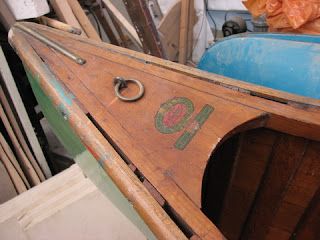
The Minetta is in the same design family as the Champlain, Mermaid, and Otonobee. Peterborough referred to this group of canoes as their "Pleasure" canoes. The Mermaid is the 14', the Minetta is the 15', the Champlain is the 16'. The Otonobee is also 16', be has finer ends, a higher sheer, a more rounded stem, and is trimmed in Mahagony.
This particular canoe is in very good shape as it was stored indoors for many years. Its varnish has darkened over time and I am trying to decide whether to leave it or strip and revarnish. It doesn't need to be stripped the way that some canoes do, but I'm thinking that I'd like to get it back to a very clean state.
Serial numbers clearly stamped on the inner stem make a good ID so much easier!
Even the seat cane is good!
You might think that my lack of recent blog posting would imply that I haven't been busy...Well it's exactly the opposite here in the shop! I have been very busy and now I finally have some time to catch up. It seems that once you fall a bit behind it becomes easier to leave things that way.
Remember Loretta? Loretta is an old Huron build canoe. Here we see new inwale ends scarphed on, new decks, and new gunnels. Now all of the trim can be sanded collectively, then varnished. Once a sealer coat of varnish is on the trim to keep the paint out, I continue with the painting, then complete the varnish.


Remember Loretta? Loretta is an old Huron build canoe. Here we see new inwale ends scarphed on, new decks, and new gunnels. Now all of the trim can be sanded collectively, then varnished. Once a sealer coat of varnish is on the trim to keep the paint out, I continue with the painting, then complete the varnish.
Wednesday, 22 September 2010
As the old freighter/racing canoe has been successful for its owner in races, I decided that it would be prudent to take the lines off of it for future reference.
I start by using masking tape to establish the centerline. On that I mark 12"intervals, then set perpendiculars.
I also ran a tight string over the keel/centerline and measured from that reference line to the bottom and to the gunnels. This measurements indicate the rocker and sheerline. While I was I at it I also measured the widths at each station.
Once that data is collected I plot it out on a large sheet of paper that is prepared with graph lines.
I then use this pointy stick thing to take the points of the curve of the hull at each station.
And transfer the points to the curve. The points are connected and establish the shape of the canoe hull. This is not an exact drawing of the canoe, as in a new canoe should not be built from these line, but it is close enough that I can refine it through the lofting process.
I start by using masking tape to establish the centerline. On that I mark 12"intervals, then set perpendiculars.
I also ran a tight string over the keel/centerline and measured from that reference line to the bottom and to the gunnels. This measurements indicate the rocker and sheerline. While I was I at it I also measured the widths at each station.
I then use this pointy stick thing to take the points of the curve of the hull at each station.
Thursday, 2 September 2010
I have an interesting canoe in for some major work. This is what is being used for the canoe races in some of the northern communities, and this one is from Cross Lake. The owner tells me that this canoe is a champion canoe and has won the races several times, so it has already earned its restoration cost. He is restoring it for his sons to race with.
These canoes are customized freighter canoes that are pulled in to make them narrow, especially at the stern. The bottoms are pushed down to eliminate the hogged rocker line.
I'll be taking the lines off of this canoe for posterity.
You know the drill-while one project is waiting for the next step another is started.
Next in line is another Huron. Amazingly, this one is in really good condition. That would be on account of it sitting in church basement for the last few decades! This canoe is one of four that belonged to a Scout group that ran out of scouters. I was contacted to help find homes for them, and the purchaser of this canoe asked me to restore it. Very straightforward: remove the trim and canvas, sand and revarnish the interior, oil the exterior, canvas, fill, paint, re-trim, paint. Done!
Notice the Sears badge? You don't see those often.
The viola da gamba project is moving along glacially. I made a bunch of kerfed lining.
And got it fitted and glued in. The rim set, called a garland in viol circles, is now complete and ready for the back, front, and neck to be fitted. I am still carving the scroll on the neck. It is a LOT of work, but it is progressing. I have the inlay on the back to do before I fit it, and I am still awaiting some fine Spruce for the front. I decided that all this work deserves a good soundboard!

And got it fitted and glued in. The rim set, called a garland in viol circles, is now complete and ready for the back, front, and neck to be fitted. I am still carving the scroll on the neck. It is a LOT of work, but it is progressing. I have the inlay on the back to do before I fit it, and I am still awaiting some fine Spruce for the front. I decided that all this work deserves a good soundboard!
Subscribe to:
Posts (Atom)